

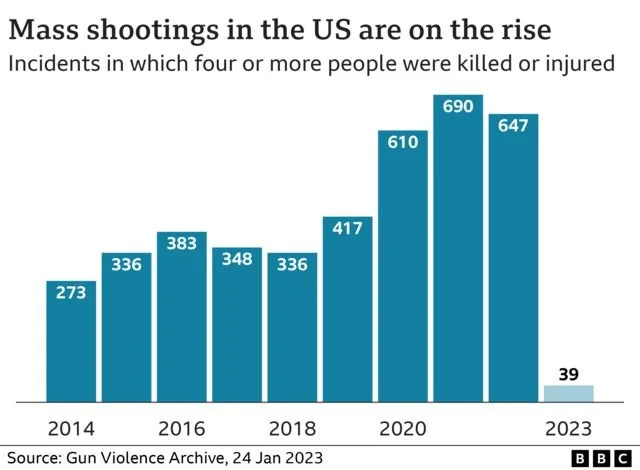
Earlier this week I was watching news coverage of another mass shooting. These occurrences have unfortunately become so common that I hardly felt any emotion at all as the reporter chronicled the death toll. According to Wikipedia there have been 39 mass shootings in the United States between January 1 and January 23. The United States is on the way to its fourth straight year of more than six hundred mass shootings. The chart below from the BBC website shows these incidents have more than doubled since 2014 when the yearly total was less than three hundred. These statistics may not come as a surprise to you, nor might it be a surprise that these appalling numbers are unique to the USA. No other country in the world comes remotely close to the mass shooting frequency of this country.
So what are the reasons for these staggering numbers and what can be done about them? We’ve been hearing for years that the way to combat gun violence is to reduce the number of guns in this country. In my opinion, this solution is overly simplistic and not very realistic. The gun availability debate has been batted around for many years in the legislative bodies of this country. But for various reasons, we as a country seem unwilling to give up the right to buy, own and carry firearms. And do we really think that making guns illegal would stop this carnage? No, I don’t think the solution will come from our lawmakers. I believe that before we can stop the violence we need to examine why so many young people, (predominantly men) feel compelled to carry out this violence.
It seems to me that an individual must be in a state of despair and hopelessness to be willing to give up their freedom and often their lives in this fashion. They must feel alienated, unrecognized and completely unable to cope in our society. Mental health is often brought up as the reason for these violent incidents. While I think many of us can agree that mental health is an important piece of the puzzle, simply citing it as a reason without follow through and change, is not a helpful solution. The people committing these acts aren’t able to cope and function in the world in a healthy way. It’s as if they are completely unprepared and unsupported in living in the environment around them. It begs the question, what might be the answer to helping them live and thrive in the world rather than committing such irrevocable acts?
ENTER BUDDHISM
I was in my mid-fifties when I was introduced to Buddhism. I’d been raised Catholic. I went to Catholic school as a child and was forced to go to mass in my younger years. But it never stuck with me. Buddhism felt somehow different to me. I suppose it does have some bits of ancient mysticism but mostly it’s a philosophy that helps explain how our minds work, and how to achieve a state of peace and contentment. There are four main tenants of Buddhism called the Four Noble Truths.
The First Noble Truth
The First Noble Truth is the idea that everyone suffers. Suffering is part of the world and each of us will experience suffering many times in our lives. This is such an important concept for all of us to learn. It doesn’t have to be approached as religious dogma, but simply information that helps to normalize the human experience that we are all walking through.. Being in a state of suffering is not abnormal.
The Second Noble Truth
The Second Noble Truth is that all of our sufferings have a cause. The Buddha taught that people need to understand the cause of their suffering in order to move forward and leave their suffering behind. For example, our physical suffering or pain can be traced back to an injury or illness. Likewise, our mental suffering is caused by some mental or emotional trigger or injury if you will. According to Buddhist philosophy, one of the main causes of mental suffering is wanting or craving. Think about it. We see objects or experiences that we think will bring us happiness and if we can’t have them for whatever reason, we suffer. And the more our minds dwell on these unfulfilled desires the more we suffer. If we continue this cycle of craving and denial, we can easily fall into a state of hopelessness.
The Third Noble Truth
The Third Noble Truth is that our suffering can end. But we must recognize that the pain only ends when we stop craving. The people involved in these mass shootings and the many other acts of both inwardly and outwardly directed violence, must be suffering. . They are most likely craving things they can never possess….perhaps those things are material, but more likely they are emotional (i.e. love, acceptance, belonging, support, etc.).
The Fourth Noble Truth
The Fourth Noble Truth shares a path by which one might find an end to their suffering. The Buddhists refer to this set of steps as the Eightfold Path. The Eightfold Path consists of Right Understanding, Right Thought, Right Speech, Right Action, Right Livelihood, Right Effort, Right Mindfulness and Right Concentration. The themes woven throughout this path encompass good moral conduct, meditation and mental development. It discusses new ways of thinking and interacting with the world around us as well as the world within us. This seems perhaps a useful starting point to our dilemma, does it not?
Recently I was watching a Dharma talk given by Ajahn Brahm, a wonderful teacher from the Buddhist Society of Western Australia BSWA. In his talk, Ajahn Brahm related a story from his past when he was in Thailand studying under Buddhist monk Ajahn Chah. He told of the swarms of mosquitoes that would descend upon the students during their long periods of silent meditation. He spoke of the misery and distraction that these insects caused. He said the students asked Ajahn Chah if they could have some repellent to keep the insects away or some lotion to soothe their skin. Ajahn Chah told his disciples that those mosquitos are your teachers, learn the lessons they are offering. We can see from this story that some of the lessons the students will learn are patience, endurance and to focus while distracted. But the overarching moral of this parable is that the world will not always be as we wish it to be. Only when the students ceased craving relief from those voracious pests did their suffering end. This teaching is a powerful one that we would all benefit from. . It may not be so much fun to practice but it will no doubt serve us greatly throughout our lives. If we could practice releasing desire and craving, we will no longer suffer from not having those desires met. Everything we DO receive or achieve in life becomes simply a beautiful bonus!
Suicide, like mass shootings, is another result of a distraught and hopeless mind. A friend of mine recently shared a short article with me. The piece talked about a Highway Patrolman from California named Kevin Briggs who patrolled the Golden Gate bridge for nearly 20 years. During his career, Patrolman Briggs saved more than 200 people who were about to commit suicide by jumping off of a bridge. What magic did he use? His superpowers were simply compassion and empathy. He didn’t try to solve their problems. He just listened and cared, which gave them hope. And hope is the cure for hopelessness. These suicidal folks got a second chance and with that, perhaps, the help they needed to live on. Together, empathy and compassion lead to an open heart, allowing individuals to form genuine connections with others, understand their needs and concerns, and build trust and respect in relationships. When we are able to empathize with others and understand their perspectives, we are better able to relate, communicate and form deep bonds with them based on shared humanity. This in turn leads to an open heart, which allows us to love and care for others in a genuine and meaningful way. Next time you’re walking down the street, perhaps you might experiment with simply smiling at those around you. And perhaps you might take a moment to notice what this does for you. And perhaps you might also never know just how much you changed someone’s life with this simple act of kindness and human connection…perhaps even saved someone’s life.
I hope some of what I’ve written here resonates with you. If so, I encourage you, as the Buddhist Teachers taught, to seek further insight and to explore and practice attaining an open heart towards all beings, which can only lead to a more compassionate world.
If you find that anything written here feels triggering or brings about strong emotion, please know that support is only a phone call away. F.L.O.W. Wellness is available to offer individual counseling. Simply email in****@****************er.org to get started. If you or someone you love is in need of more immediate support the Crisis Text Line, with highly trained and supportive volunteers, is available 24 hours a day 7 days a week and can be reached by texting HOME to 741741.